
A Minneapolis mansion tour is really a tour of about a dozen clients and half a dozen architects. Between Loring Park, Park Avenue and Mount Curve there is a twenty-year stretch — roughly the 1880s to the 1920s — when lumber money, flour money and grain money all decided to build at once, and hired a small circle of architects to do it.
Here is who designed what, so the houses you pass on the Gilded Age Mansion Tour stop being a blur of big stone boxes.
Edwin Hewitt
Hewitt is the name you will hear most on the tour, and he bookends it. He is credited with the Eugene and Merrette Carpenter Mansion at 300 Clifton Avenue — the Georgian one, the house you can actually sleep in — and, decades later, with the Carolyn Christian Mansion at 2303 Third Avenue South, built in 1920.
His firm, Hewitt and Brown, also did a good deal of the Minneapolis you walk past without noticing. The City’s own landmark record credits the firm with the Renaissance Revival Architects and Engineers Building of 1920 on Second Avenue South. If you like the Carpenter Mansion, you like Hewitt; the rest of the city is homework.
William Channing Whitney
Whitney is the Richardsonian Romanesque man — the heavy rusticated stone, the round arches, the towers. Three houses on the tour are his: the Alden Smith Mansion of 1887 at 1400 Harmon Place, the Merrill Mansion of 1884 at 2116 Second Avenue South (later the home of the designer John Scott Bradstreet), and the Charles J. Martin Mansion of 1903 at 1300 Mount Curve.
The City of Minneapolis calls Whitney a master architect in its landmark designations. Watching his work move from 1887 stone to a 1903 Mount Curve house is a compressed lesson in how quickly American domestic taste changed.
George Washington Maher
The Winton Mansion at 1324 Mount Curve, built in 1910, is the outlier on the route and the one architecture people come for. Maher was a Chicago architect associated with the Prairie School, and he worked by what is usually called the motif-rhythm theory — one form repeated through a whole building, inside and out. SAH Archipedia documents the same approach in his Winona bank of 1914, where a lotus motif runs through the glass, the stone and the metalwork.
After a morning of Romanesque towers, the horizontal Winton house looks like a different century. It nearly is.

Long and Long, and a name people get wrong
The Ann and Frank Semple Mansion of 1901 at 100 West Franklin is credited on our tour to Franklin and Louis Long. One correction worth making, because it circulates constantly: Minneapolis City Hall was not designed by that partnership. The City’s own landmark record gives City Hall to Long and Kees — Franklin Long with Frederick Kees, the firm that also produced the Lumber Exchange, the Masonic Temple and the Flour Exchange. Franklin Long’s later firm with his son was a different practice. Same surname, different building.
The two you can actually go inside
Most Gilded Age mansions in Minneapolis are private. Two on the route are not.
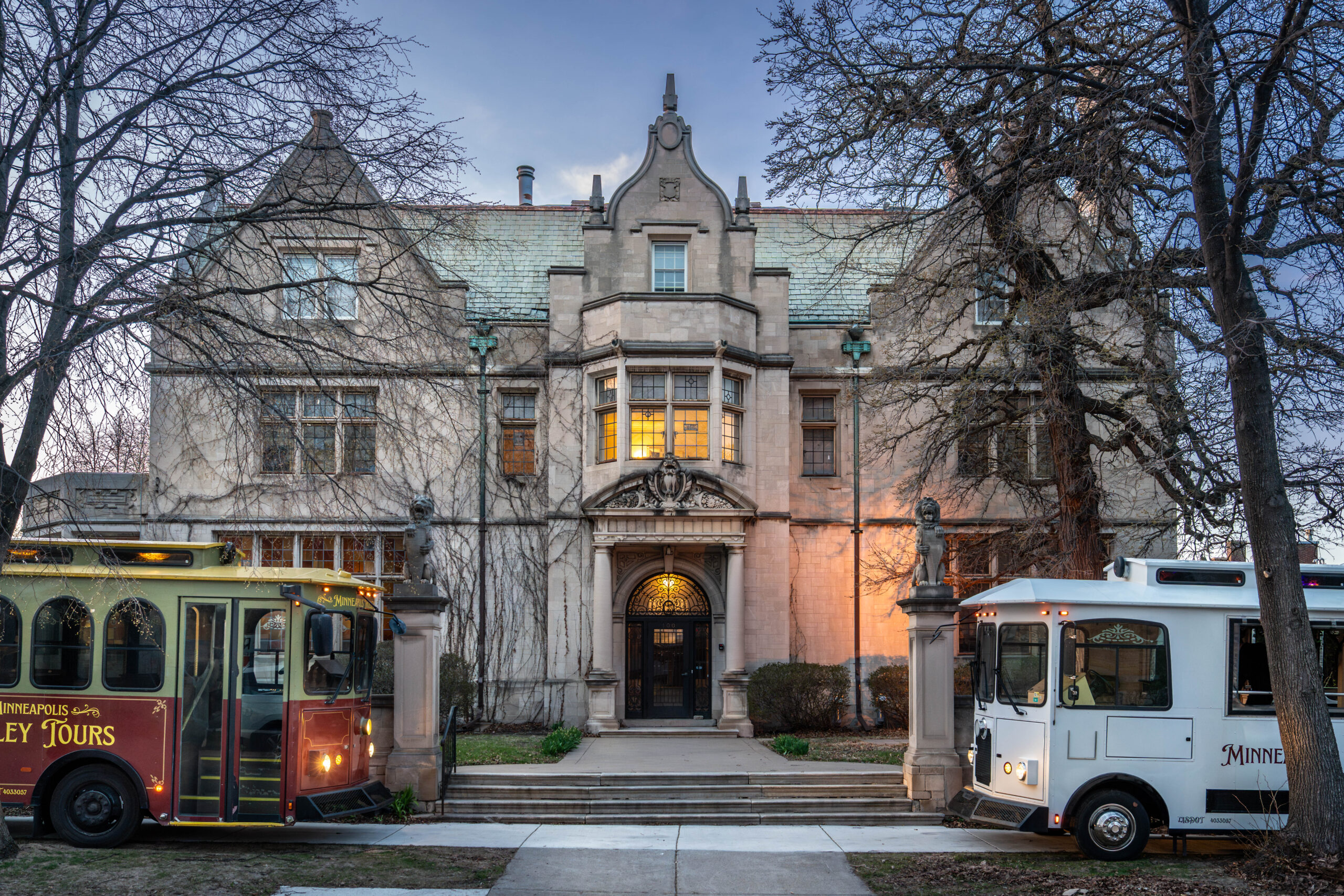
The Charles S. Pillsbury Mansion at 100 East 22nd Street is now the Pillsbury Club, and the trolley departs from its front door. Its build date is a genuinely unresolved question: our tour page says 1913, the City’s landmark record says 1912–1914, and the house’s own history says 1916. Nobody has reconciled those, and we would rather show you the disagreement than pick one.
The Carpenter Mansion at 300 Clifton Avenue is now 300 Clifton, and it is the only mansion in Minneapolis you can tour and then sleep in. We wrote about how the two houses differ in more detail.

The Park Avenue cluster
Park Avenue was the address, and the route reads like a list of what the money did next. The Charles Harrington Mansion of 1902 at 2540 Park is Italian Renaissance Revival and around 30,000 square feet, with interiors by John Scott Bradstreet. The George Peavey Mansion of 1907 sits at 2210 Park; the Sumner McKnight Mansion of 1892 at 2200 Park is Richardsonian Romanesque again.
And at 2600 Park is the Turnblad Mansion of 1903, French Renaissance Revival, built by a Swedish-American newspaper owner and now the American Swedish Institute. It is the one house on the list with regular public tours run by somebody else: ASI runs educator-led mansion tours at 1:30 p.m. most open days, and its holiday exhibition typically opens in mid-November.
Why they are all in one part of the city
None of this is coincidence. These houses were built by lumber, milling and grain families in the two decades when Minneapolis was, in its own phrase, the flour milling capital of the world. The Minnesota Historical Society’s Mill City Museum — a National Historic Landmark built inside the ruins of what was once the largest flour mill on earth — is where that story lives. The mansions are what the profits looked like once they came home.
Several of the houses are on the National Register of Historic Places, and a good many more are locally designated Minneapolis landmarks.
How to see them
The Gilded Age Mansion Tour is the efficient way to do the route — a vintage trolley, a guide, and no parking problem, departing from the Pillsbury Club at 100 East 22nd Street. Dates are on the tour calendar, and for a group of your own there is group and private hire.
Make a weekend of it: stay in the Carpenter Mansion at 300 Clifton, or take a furnished downtown studio by the month at Oakland’s on 9th if you are here longer. Dinner and a drink before or after are at the Pillsbury Club, in the mansion the trolley leaves from.
More to plan with: our lists of the best Minneapolis landmarks, the best Minneapolis tours, the best Minneapolis museums, the best date ideas, and the restaurants with the most atmosphere. Also worth reading: what you actually see on a mansion tour.
Book the tour
Architects are more fun when you are looking at the buildings. Grab seats at the box office and let somebody else do the driving — it really is the thing to do in Minneapolis on an autumn afternoon.
Keep reading: What true crime stories really happened in Minneapolis?