
Ten blocks apart, both on the National Register, both built by families who made their money out of Minnesota dirt — and you can walk into either one. That last part is rarer than it sounds. Most Gilded Age mansions in this city are law offices, apartments or somebody’s very lucky private home. Two of the best are open to the public, and guests ask us constantly which one to do.
Short answer: they are near-opposites, and that is exactly why you should see both. Here is the difference.
The Carpenter Mansion: Georgian, restrained, and full of art-world history
Start at 300 Clifton Avenue in Loring Park. The house went up in 1887 for a coal dealer named C.M. Douglas, and in 1905 it was bought by Eugene and Merrette Carpenter, who came from lumber-milling money. They brought in architect Edwin Hewitt to reshape it, and the Minneapolis designer John S. Bradstreet handled the interiors — the same Bradstreet whose Arts and Crafts work turns up in half the great houses in this city.
The result is Georgian: symmetrical, pale, orderly, more polite than dramatic. Roughly 12,000 square feet on a one-acre double lot, fourteen bedrooms, and detail work that rewards standing still. It went on the National Register in 1977 and became a Minneapolis landmark the following year — the City of Minneapolis keeps the official landmark record.

The reason this house matters beyond the architecture: Eugene Carpenter chaired the Minneapolis Society of Fine Arts from 1911 to 1922 — the organization that became the Minneapolis Institute of Art. A meaningful chunk of the city’s cultural infrastructure was argued into existence in these rooms. It is also the only mansion in Minneapolis you can tour and sleep in; the house operates today as the 300 Clifton bed and breakfast.
The Pillsbury Mansion: English Gothic, and built out of a lost coin toss
Now go to 100 East 22nd Street, and the mood changes completely. This is the Charles S. Pillsbury house — gray Bedford limestone over reinforced concrete, built between 1912 and 1914 by the H.N. Leighton Company to designs by the Minneapolis firm Hewitt and Brown, at a cost of about $300,000. English Gothic Revival, which in practice means heavy stone, deep-set windows and dark carved wood where the Carpenter house has light and plaster. The city landmark listing has the full record.
Our favorite part is why it exists at all. Around 1912, Charles and his twin brother John flipped a coin to settle which of them would take over the family mansion on East 22nd. Charles lost — so he built his own, across the street. It is the most Minneapolis story imaginable: lose a coin toss, respond by commissioning a limestone Gothic pile.
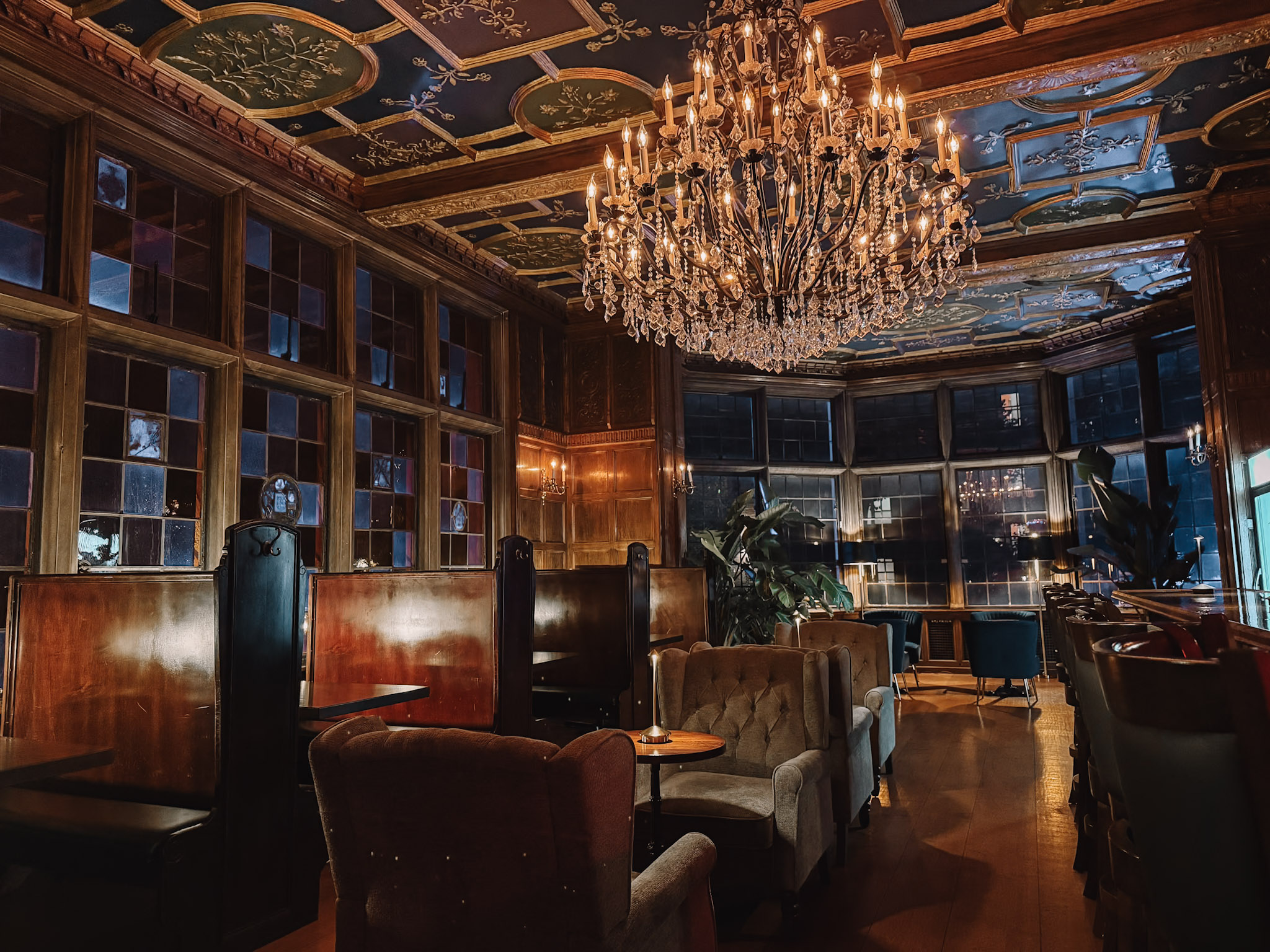
Today the house is the Pillsbury Club — a private, reservation-required club with a speakeasy-style bar, a dining room, private club rooms, a curated market and year-round mansion tours, plus the occasional paranormal ghost hunt and psychic reading for anyone who suspects the building has opinions. It is also where our trolley picks you up.
Georgian vs. Gothic, in one sentence
The Carpenter Mansion is a house built to host an arts committee. The Pillsbury Mansion is a house built to win an argument. Twenty-five years apart, ten blocks apart, and completely different nervous systems.
How to see both in an afternoon
Our Gilded Age Mansion Tour is the efficient way to do it. The trolley works the old mansion district — Clifton, LaSalle, Park Avenue, Mount Curve — with a guide filling in who built what and why, and you get inside as well as outside. Along the route you will pass the Van Dusen, Semple, Gale, Peavey and Turnblad mansions, which is a lot of Minnesota flour, grain and lumber money in one loop. If you want a sense of the pacing first, we broke it down in what you actually see on a Minneapolis mansion tour.
The season nobody expects: Christmas
Here is a quirk worth knowing. The American Swedish Institute’s Turnblad Mansion is the other great tourable house in town, but ASI does not run its guided mansion tours during the holiday exhibition — the building turns over to holiday programming instead. Which means that from late November onward, these two houses are effectively the mansion tours still running in Minneapolis.
They are also better in December than in July. Historic houses were designed for candlelight and short days; a decorated Gothic hall in the dark is doing exactly what it was built to do. The Holiday Light Ride boards from the Pillsbury Club all season, so you can stack a mansion visit and a lights ride into the same evening — details in our guide to booking a holiday lights trolley for a group.
Make a day of it
Both mansions sit in the middle of a genuinely good neighborhood for wandering. Our lists of the best cocktail bars in Minneapolis, the most atmospheric restaurants and the best family activities will fill in the hours on either side. Staying downtown for a longer stretch? Oakland’s on 9th rents furnished studios by the month.
Ready to go inside? Book the Gilded Age Mansion Tour and see both houses the way they were meant to be seen — from the inside, with someone who knows the stories. Call us at 612-900-3220 if you want to put a group together.
Keep reading: Where Are the Best Places to Take Photos in Minneapolis?